NC congressional map critics drop federal lawsuits
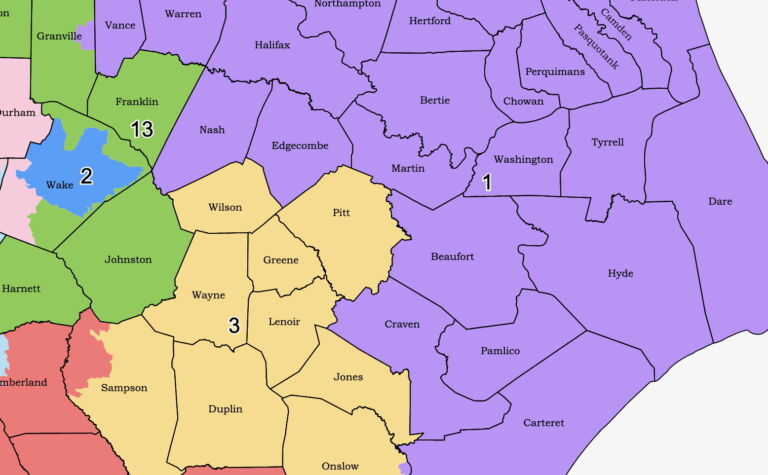
Two sets of plaintiffs who challenged North Carolina’s new congressional map in federal court have dropped their lawsuits. Federal judges had refused in November to block the map from being used for this year’s elections.
Plaintiffs in cases known as Williams v. Hall and NAACP v. Berger filed a stipulation of dismissal Friday in US District Court.
The cases are dismissed “with prejudice,” meaning that neither set of plaintiffs can file suit over the existing congressional map again. All parties in the legal dispute will cover their own costs for the portion of the case dealing with the current congressional map.
Meanwhile, the plaintiffs “will each make a payment of costs to Legislative Defendants no later than 30 days after the filing of this stipulation” to cover the rest of the dispute, which involved both North Carolina’s previous congressional map and maps for state House and Senate districts. Republican legislative leaders defended the maps in court against both sets of plaintiffs.
The three-judge panel overseeing the case issued a Nov. 26 ruling rejecting an injunction against the congressional map. That decision arrived five days before candidate filing opened for the 2026 elections.
The Republican-led General Assembly redrew the congressional map last October with Senate Bill 249 by shifting voters between Congressional Districts 1 and 3 in eastern North Carolina. Their stated goal was to help a GOP candidate win in District 1, a seat now held by Democratic US Rep. Don Davis. A Republican win in District 1 could shift the state’s US House delegation from 10-4 in Republicans’ favor to an 11-3 GOP advantage.
US Appeals Court Judge Allison Jones Rushing and District Court Judges Richard Myers and Thomas Schroeder issued a 57-page order one week after holding an injunction hearing in Winston-Salem. The same panel issued a 181-page order earlier in November rejecting arguments the plaintiffs had made against maps drawn for the 2024 elections.
The Nov. 26 order rejected each argument for an injunction. Some arguments came from plaintiffs led by the North Carolina State Conference of the NAACP and left-of-center activist group Common Cause. A second group identified as the Williams plaintiffs worked with Democratic operative Marc Elias’ law firm.
Judges tackled the complaint that a mid-decade redistricting process led to “malapportionment,” a situation in which some congressional districts would have too many voters while others would have too few to comply with federal one-person, one-vote standards.
“According to Williams Plaintiffs, because S.B. 249 was ‘an unnecessary, mid-decade change to districts that had already been enacted by the state legislature,’ the General Assembly was barred from relying on the ‘legal fiction’ that census data remains accurate for ten years and, without reliable data, could not redistrict at all,” the judges wrote.
“We are not persuaded. First, Williams Plaintiffs have presented no evidence showing the current population of the 2025 plan’s congressional districts, much less any evidence that any population deviations are constitutionally severe,” the court order explained.
“[M]ore fundamental, Supreme Court precedent cuts sharply against Williams Plaintiffs’ argument that the General Assembly was not entitled to use the 2020 census data in enacting S.B. 249,” the panel added.
The federal judges also rejected the plaintiffs’ First and 14th Amendment claims.
“The gist of Plaintiffs’ claims is that the General Assembly violated the Constitution by engaging in mid-decade redistricting to punish them for being Democrats, and to favor Republicans, without a legitimate reason for doing so,” the judges wrote.
“Plaintiffs have not made a clear showing that they are likely to succeed on the merits of any of these claims,” the order explained. “Claims of excessive partisanship in redistricting present political questions not suitable for resolution in federal courts. And the Supreme Court has rejected the argument that a mid-decade redistricting undertaken for partisan reasons presents an exception to this rule.”
Supreme Court precedents, including the 2019 decision in North Carolina’s Rucho v. Common Cause, “present formidable obstacles to Plaintiffs’ claims,” the judge noted. “Plaintiffs have not shown that their First Amendment claims and Fourteenth Amendment partisanship claim are likely to be justiciable, much less successful.”
The panel also rejected the plaintiffs’ claims that the new congressional map “intentionally dilutes the voting strength of black North Carolinians” in Congressional Districts 1 and 3.
“[W]e conclude that Williams Plaintiffs, at this stage of the case, have failed to make a clear showing that the General Assembly likely enacted S.B. 249 with the intent to ‘minimize or cancel out the voting potential’ of black North Carolinians living in CD 1 or 3,” the judges wrote. “We therefore deny their motion for a preliminary injunction on their Fourteenth Amendment intentional vote dilution claim.”
Judges emphasized that the new congressional map shifted entire counties between the two targeted districts.
“[N]one of the counties moved between CD 1 and 3 are majority black, and none belong to what Plaintiffs characterize as the Black Belt,” they wrote. “Moving whole counties, as opposed to smaller blocks of voters, within this region does not raise an inference of racial targeting.”
“NC congressional map critics drop federal lawsuits” was originally published on www.carolinajournal.com.


